
How Much Should Interior Design Cost for a Remodel?
If you're planning a remodel, you've probably already discovered that interior design fees can be surprisingly difficult to understand.
One designer charges hourly. Another charges a flat fee. Another quotes a percentage of the project. And sometimes two designers can give you dramatically different proposals for what appears to be the same remodel.
So, how much should interior design actually cost for a remodel?
For many residential remodeling projects, professional interior design can range from a few thousand dollars for a smaller, defined scope to $20,000–$75,000+ for a large or whole-home remodel.
The more important question, though, isn't simply how much does the designer charge?
It's:
What am I actually getting for that fee?
Typical Interior Design Costs for a Remodel
Interior design fees vary based on the size and complexity of the project, the designer's experience, your location, and how involved the designer will be throughout construction.
Here are some general ranges homeowners may encounter:
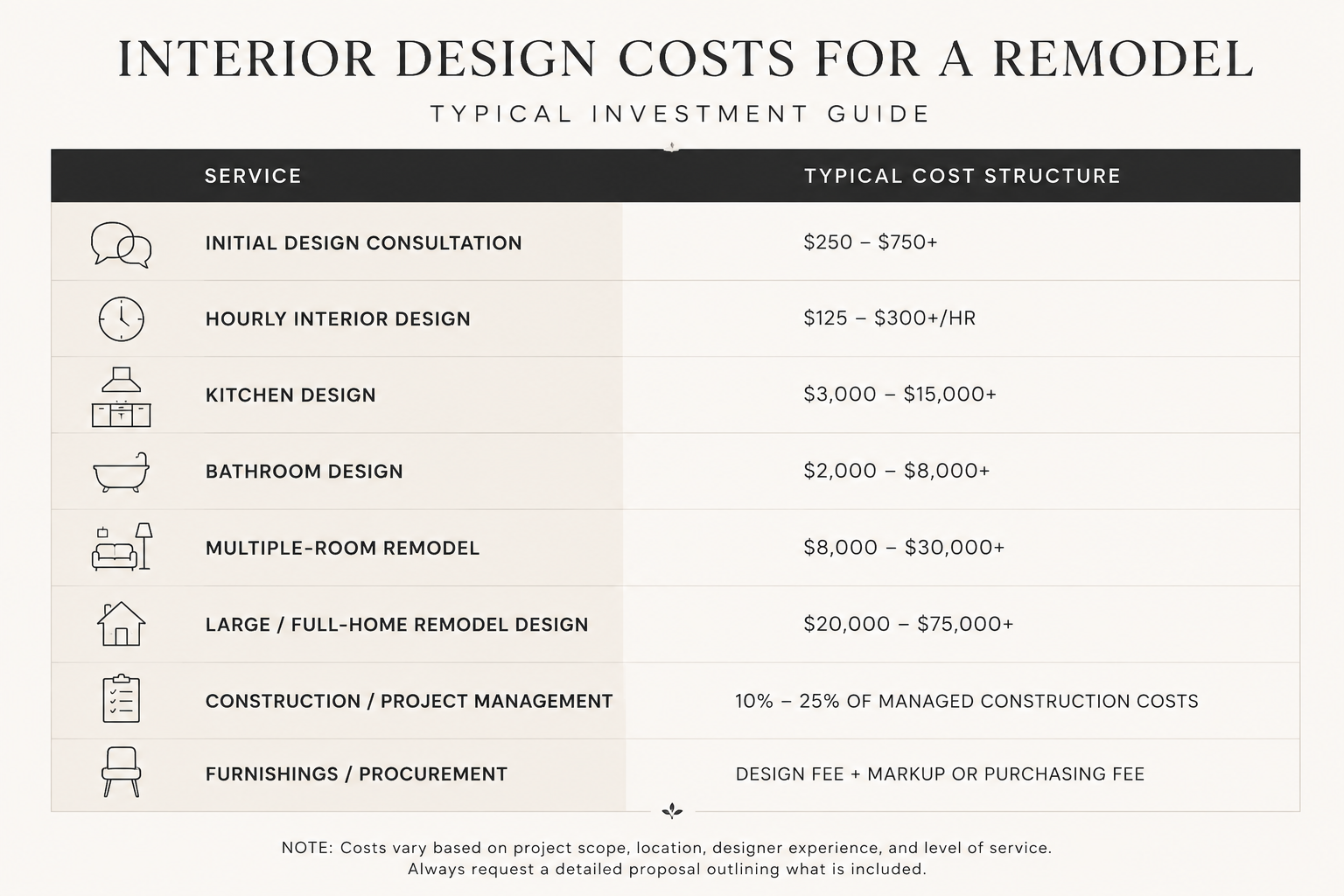
These are general guidelines rather than fixed industry pricing. A highly detailed kitchen remodel, for example, could require considerably more design work than a simple cosmetic renovation of several rooms.
Why Is There Such a Big Range in Interior Design Fees?
Because "interior design" can describe very different levels of service.
One homeowner may need help choosing countertops, tile and paint.
Another may need a designer to rethink the entire floor plan, design custom cabinetry, create lighting and electrical plans, select every finish and fixture, coordinate with contractors, review installations and manage hundreds of decisions throughout construction.
Those aren't the same service.
A comprehensive remodel can involve:
Space planning and furniture layouts
Kitchen and cabinetry design
Bathroom layouts
Flooring selections
Tile and stone selections
Countertops
Plumbing fixtures
Lighting selections and plans
Electrical and outlet planning
Paint and wall finishes
Hardware
Millwork and built-ins
Finish schedules and specifications
Drawings and elevations
3D renderings
Contractor coordination
Site visits
Revisions
Procurement and purchasing
Installation and styling
The more responsibility your designer takes on, the greater the design investment will typically be.
How Do Interior Designers Charge for Remodels?
There isn't one universal pricing model.
Hourly Design
Some designers charge an hourly rate, commonly around $125–$300+ per hour, depending on experience, market and specialty.
Hourly design can work especially well when the scope isn't completely defined or when a homeowner needs ongoing professional guidance rather than full-service design.
Flat-Fee Design
A designer may determine the expected amount of work and provide a fixed design fee.
For example, a designer might quote a flat fee for designing a kitchen, bathroom or entire home.
The benefit is predictability. However, homeowners should carefully review what is included, how many revisions are allowed and what happens when the scope changes.
Percentage-Based Fees
For larger remodels, design or project-management fees may also be calculated as a percentage of construction costs.
This is particularly common when the designer is heavily involved throughout construction.
Procurement and Purchasing Fees
If your designer purchases furniture, lighting, plumbing, materials or other products on your behalf, there may also be procurement fees, purchasing fees or product markups.
These should be clearly explained in the designer's agreement.
What Does an Interior Design Consultation Cost?
A consultation is often the first step in the remodeling process.
At Lake Hazel Design, our initial interior design consultation is $500 for up to two hours.
The consultation gives us an opportunity to walk through your home, understand what you're trying to accomplish, discuss design direction, identify potential challenges and determine what level of design support makes sense for your project.
One important distinction:
A consultation is not the same thing as designing an entire remodel.
This is an area where homeowners sometimes understandably get confused.
During a consultation, a designer can provide significant professional insight and direction. But developing layouts, researching products, creating drawings, specifying materials, coordinating selections and preparing the project for construction requires considerably more time after the consultation.
Why Can Paying for Interior Design Actually Save Money?
Adding a designer may initially feel like adding another expense to an already expensive remodel.
But poor decisions during construction can cost substantially more.
Imagine installing the wrong flooring throughout the house.
Ordering cabinetry that doesn't work with the appliance specifications.
Discovering after framing that an outlet, sconce or plumbing fixture is in the wrong location.
Or selecting finishes independently and realizing after installation that they don't work together.
Remodeling mistakes aren't just annoying.
They're expensive to undo.
A designer's job isn't simply to make the house beautiful. Good interior design creates a plan before expensive construction decisions become permanent.
What Should You Ask Before Hiring an Interior Designer?
Instead of comparing designers based only on the bottom-line number, compare the scope of services.
Ask:
What exactly is included in the design fee?
Are drawings included?
Are finish and fixture selections included?
How many revisions are included?
Are contractor meetings included?
Are site visits included?
Who communicates with the contractor?
Are 3D renderings included?
Is procurement included?
Are there product markups?
What happens if the scope changes?
How is additional design time billed?
Does the designer stay involved during construction?
A $5,000 proposal isn't necessarily cheaper than a $10,000 proposal if you'll ultimately need to hire additional professionals or pay for additional services to complete the project.
Compare deliverables and responsibility, not just price.
How Much of My Remodel Budget Should Go Toward Design?
There isn't a perfect percentage for every project.
A cosmetic remodel requiring mostly finish selections will need far less design work than a renovation involving walls, cabinetry, kitchens, bathrooms, lighting and custom details.
The earlier you involve your designer, however, the more opportunity they have to help establish realistic priorities and prevent expensive changes later.
Ideally, design should happen before construction begins—not while your contractor is standing on site asking which tile you want tomorrow.
That's when remodeling gets expensive, stressful and unnecessarily chaotic.
Should I Hire an Interior Designer Before a Contractor?
For many substantial remodels, it's helpful to involve the designer very early—sometimes even before selecting the contractor.
The designer can help develop the scope, identify priorities and create enough of the design direction for contractors to provide more meaningful pricing.
Otherwise, you may end up asking several contractors to bid on a project that hasn't actually been fully defined yet.
And when everyone is pricing something different, comparing bids becomes extremely difficult.
So, Is an Interior Designer Worth the Cost for a Remodel?
If you're changing layouts, remodeling a kitchen or bathroom, selecting a large number of finishes, investing significantly in your home or simply want the project to feel cohesive when it's finished, professional interior design can be one of the most valuable parts of the remodeling process.
You're not only paying someone to choose beautiful things.
You're paying for someone to think through how hundreds of individual decisions work together before those decisions become expensive construction.
That's a very different job.
Planning a Remodel?
If you're considering a kitchen, bathroom, multiple-room or whole-home remodel, the best first step is understanding the scope of the project.
At Lake Hazel Design, we begin with a $500 interior design consultation for up to two hours. We'll walk through your project, discuss what you want to change, identify priorities and determine what level of design support makes sense before you move deeper into construction.
Because the goal isn't to spend more money on your remodel.
It's to make better decisions with the money you're already planning to spend.