
Interior Designer vs. General Contractor: Who Does What?
If you're planning a remodel, one of the first questions you may have is:
Do I need an interior designer, a general contractor—or both?
The short answer is that they typically do very different jobs.
An interior designer helps determine what should be designed, how the space should function, what materials and finishes should be used, and how all of those decisions work together.
A general contractor figures out how to build it, coordinates the trades, manages construction, and turns the plans into a finished space.
On a well-run remodel, the designer and contractor aren't competing roles. They're part of the same team.
What Does an Interior Designer Do?
Interior design—especially for remodeling—is about much more than choosing furniture, paint colors, and pretty finishes.
A qualified interior designer may help with:
Space planning and layouts
Kitchen and bathroom design
Cabinetry layouts
Lighting plans
Plumbing fixture selections
Flooring
Tile and stone
Countertops
Paint and wall finishes
Millwork and built-ins
Furniture and furnishings
Finish specifications
3D renderings and visualizations
Construction and permit drawings, depending on the designer and project
Coordination with contractors, architects, engineers, vendors, and trades
Reviewing design details during construction
The designer is looking at the project from the perspective of function, aesthetics, usability, proportion, materials, and the overall experience of the finished home.
For example, imagine you're remodeling a kitchen.
A designer isn't simply choosing cabinet colors.
They may determine where the refrigerator should go, whether an island will actually fit, how large the walkways should be, where outlets and lighting are needed, how cabinetry should function, which countertop works with the design, and how the kitchen connects visually and functionally to the surrounding rooms.
Those decisions ideally happen before construction begins.
What Does a General Contractor Do?
The general contractor is primarily responsible for executing and managing the construction.
Depending on the project and contractor, that can include:
Developing construction pricing
Hiring and scheduling subcontractors
Coordinating demolition
Framing
Electrical
Plumbing
HVAC
Drywall
Tile installation
Flooring installation
Cabinet installation
Painting
Construction scheduling
Ordering or coordinating construction materials
Managing job-site logistics
Inspections and permits
Construction quality control
Solving field conditions that arise during construction
Think of the contractor as the person responsible for getting the project built.
The contractor may have valuable opinions about materials, layouts, and finishes based on years of construction experience. But construction expertise and interior design expertise aren't necessarily the same thing.
Interior Designer vs. General Contractor
Here's a simple way to think about the difference:
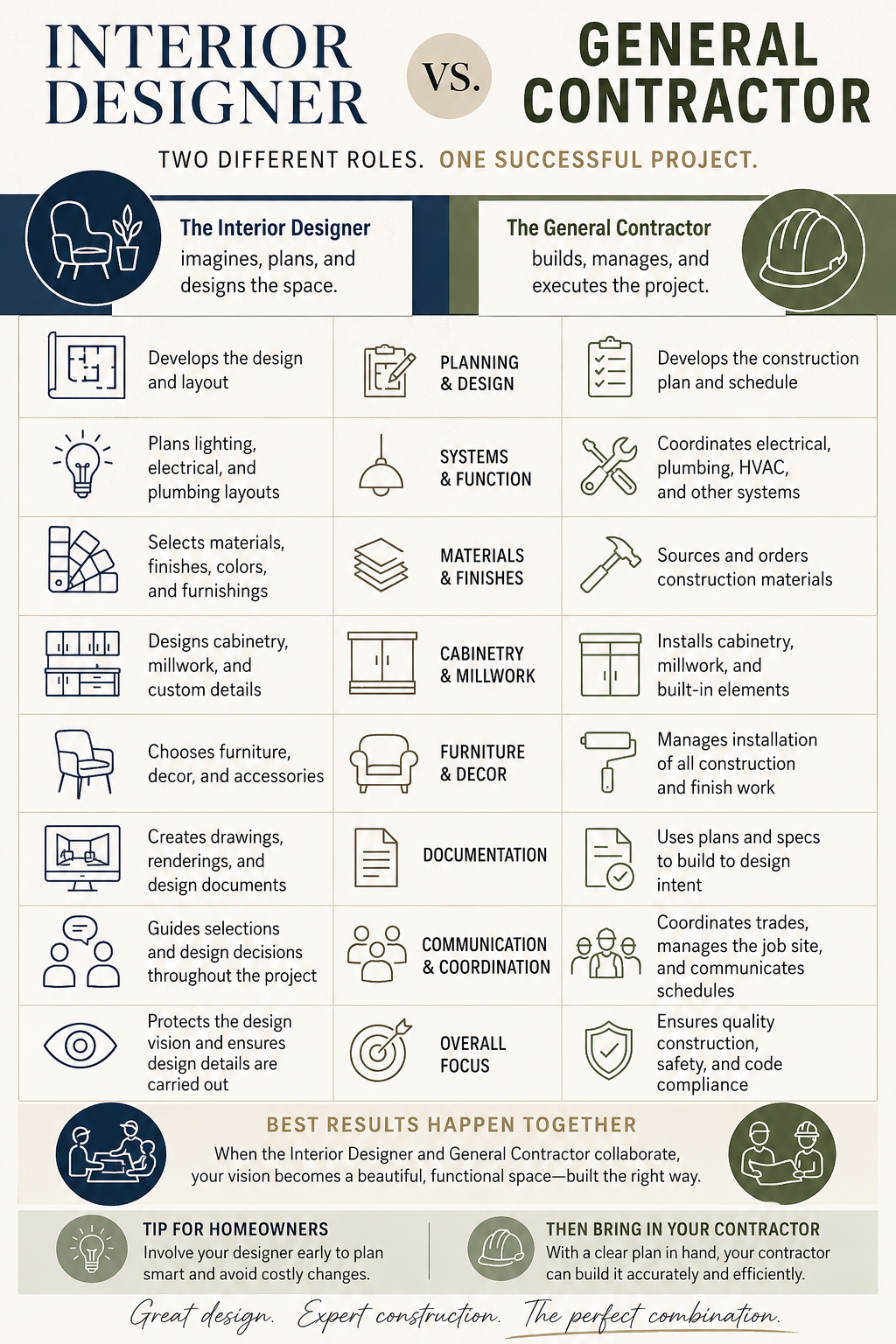
There can absolutely be overlap between the two roles.
Some contractors provide design-build services. Some interior design firms provide construction management or general contracting services. Some projects also require an architect or engineer.
The important question isn't necessarily the person's title.
It's what services they are actually qualified and contracted to provide.
Can a General Contractor Design My Remodel?
Sometimes—but it's important to understand what "design" means.
Many experienced contractors are excellent at suggesting practical solutions. They may know that moving a wall will create a better layout or that one material will perform better than another.
But asking a contractor:
"What do you think we should do here?"
is different from going through a complete design process.
Without that process, homeowners can end up making dozens—or hundreds—of individual decisions while construction is already underway.
Suddenly you're being asked:
What tile do you want?
Where should the sconces go?
What grout color?
Which faucet?
How high should the backsplash be?
What cabinet hardware?
Which countertop edge?
Where should the outlets go?
What size pendant lights?
Construction is moving, the subcontractor needs an answer, and you have 20 minutes to decide.
That's where expensive mistakes and decision fatigue can creep in.
Why Designing Before Construction Can Save Money
One of the biggest advantages of involving an interior designer early is simply making decisions before those decisions become urgent.
Changing something on paper is relatively easy.
Changing it after framing, electrical, plumbing, cabinetry, or tile installation is another story.
Good pre-construction design can help reduce:
Change orders
Material reselections
Incorrect quantities
Layout problems
Cabinetry mistakes
Lighting mistakes
Delays caused by unanswered design questions
Rush shipping
Rework
Miscommunication between trades
An interior designer does cost money.
But design fees should be considered alongside the potential cost of not having the project fully designed before construction begins.
A $2,000 design decision made correctly on paper can be considerably less expensive than tearing out $10,000 worth of completed work.
Should I Hire the Interior Designer or Contractor First?
For a design-heavy remodel, there's a strong argument for bringing the designer in before—or at least at the same time as—the contractor.
The designer can help develop the scope and design before contractors provide detailed pricing.
That matters because it's difficult for contractors to price something accurately when nobody has decided exactly what they're building.
Instead of:
"We want to remodel the kitchen."
the contractor can eventually price something much more specific:
"We're removing this wall, installing this cabinetry configuration, relocating these fixtures, using this flooring, installing this tile, adding these lighting locations, and using these specified materials."
The more developed the design is, the better the construction team can understand the intended scope.
What About Design-Build Companies?
Design-build companies combine design and construction under one company or team.
This can be a great solution when the company has strong professionals handling both sides of the process.
But don't assume that every company advertising "design-build" has an experienced interior designer leading the design.
Ask who will actually design your project.
What is their background?
What drawings will they produce?
How are materials selected?
Will you see layouts or renderings before construction?
How are design revisions handled?
Who is responsible for protecting the design intent once construction begins?
The structure of the company matters less than the quality of the people doing the work.
Do I Need Both an Interior Designer and a General Contractor?
For many substantial remodels, yes.
If you're changing kitchens, bathrooms, walls, cabinetry, lighting, plumbing locations, flooring, or multiple rooms, having both design and construction expertise can make the process significantly smoother.
A strong project team may include:
Homeowner → Interior Designer → General Contractor → Subcontractors and Vendors
Depending on the project, an architect and structural, mechanical, electrical, or other engineers may also be involved.
Each professional brings a different area of expertise.
When Might You Only Need a Designer?
You may not need a general contractor if your project is primarily cosmetic, such as:
Furniture and furnishings
Paint
Window treatments
Styling
Wallpaper
Lighting replacements
Decorative finishes
Minor room updates
Individual trades may be enough to complete the work.
When Might You Only Need a Contractor?
For straightforward repairs or construction where there are very few design decisions, you may not need a full interior design scope.
For example, replacing damaged drywall or rebuilding something exactly as it existed may primarily be a construction project.
But the more you're asking:
"What should this space become?"
rather than:
"Can you rebuild this?"
the more valuable design becomes.
The Best Remodels Start With Collaboration
Interior designers and general contractors shouldn't be working against each other.
The best projects happen when both sides communicate early.
The designer needs to understand what is practical to build and what construction decisions affect the budget.
The contractor needs clear information about what the finished project is supposed to look like.
And the homeowner needs both teams working toward the same result.
At Lake Hazel Design, we approach remodeling with that collaboration in mind. We help homeowners develop the design, make selections, create clear direction for construction, and coordinate design decisions with the people responsible for building the project.
Because a beautiful rendering isn't enough.
It has to be buildable.
And construction that's technically correct isn't enough either.
It still has to become the home you actually wanted.
Frequently Asked Questions
Does a general contractor choose finishes?
Some do, and many will help homeowners source materials. However, detailed finish selection and coordination are typically part of the interior design process. Clarify what's included in your contractor's scope before assuming selections are covered.
Can an interior designer hire contractors?
Depending on the firm's services and local requirements, an interior designer may recommend contractors, coordinate with them, manage portions of the project, or offer construction-related services. Always ask exactly what the designer's contract includes.
Do I need an architect too?
Possibly. Major structural changes, additions, new construction, and certain permitting requirements may require architectural or engineering services. Requirements vary by jurisdiction and project.
Who manages the remodel?
That depends on your contracts. The general contractor typically manages construction and subcontractors, while the interior designer manages the design process and design-related decisions. Some firms offer broader project or construction management services.
When should I contact an interior designer for a remodel?
Ideally, before construction begins and before all major decisions have already been made. Early involvement gives the designer more opportunity to improve the layout, coordinate selections, identify potential issues, and create documentation the construction team can use.
Planning a Remodel?
If you're considering a kitchen, bathroom, or whole-home remodel, don't wait until demolition starts to figure out the design.
Starting with a clear plan can make estimating more accurate, construction more organized, and the finished home much closer to what you imagined.
Lake Hazel Design helps homeowners bridge the gap between design and construction—so the project isn't just beautiful on paper, but thoughtfully planned for the way it will actually be built.